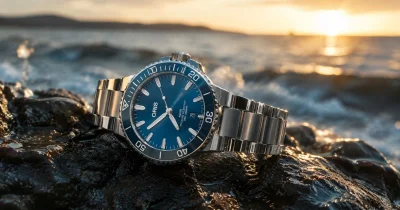

Your First Dive Watch: A Beginner’s Guide
The dive watch is perhaps the most iconic category in all of horology. Born from the practical needs of underwater explorers, it has evolved into a symbol of adventure, durability, and understated cool. Yet for the first-time buyer, the sheer number of options, specifications, and terminology can feel overwhelming.
Let me walk you through everything you need to know before buying your first dive watch—no diving certification required.
What Exactly Is a Dive Watch?
At its simplest, a dive watch is a timepiece designed to withstand immersion underwater and help a diver track elapsed time. The International Organization for Standardization (ISO) maintains a specific standard—ISO 6425—that defines what a true dive watch must be.
According to ISO 6425, a dive watch must be water resistant to a minimum of 100 meters, feature a timing device (typically a unidirectional rotating bezel) that allows the diver to track elapsed time up to 60 minutes, remain legible in total darkness at a distance of 25 cm, resist magnetic fields, and withstand a specific shock test. Compliance with this standard is voluntary, but it remains the gold standard for separating genuine dive tools from merely “diver-style” watches.
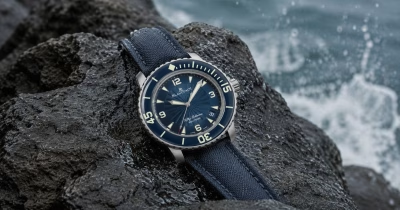
The modern dive watch as we know it was born in the early 1950s with the introduction of two legendary models: the Blancpain Fifty Fathoms and the Rolex Submariner. Both were developed in response to the needs of military and professional divers, and both established the visual and functional template that virtually every dive watch follows to this day.
The ISO 6425 Standard: A Guideline, Not a Rule
Many first-time buyers become fixated on ISO 6425 certification as if it were a legal requirement. It’s worth remembering that it is a standard, not a law. Watches that predate the standard, or that simply choose not to pursue certification, can still be perfectly capable dive tools.
That said, the basics of ISO 6425 are sound and worth understanding. The standard requires:
- Water resistance to at least 100 meters
- A secured measuring system (unidirectional bezel) to indicate dive time
- Visibility in total darkness at 25 cm distance
- Resistance to magnetic fields (4,800 A/m)
- Shock resistance (a 3kg hammer at 4.43 m/s impact velocity)
A watch that meets these criteria has been tested under conditions that replicate actual diving environments. It is, quite simply, more reliable underwater than a watch that hasn’t been put through those paces.
The Core Features That Matter
Water Resistance Rating
Water resistance is the defining characteristic of any dive watch. Here is a practical breakdown of what the numbers actually mean:
- 30m: Splashes and rain only
- 50m: Surface swimming, not diving
- 100m: Snorkelling and moderate water activities (the ISO minimum)
- 200m: Recreational sport diving
- 300m and beyond: Professional diving
Here is the key insight that surprises many beginners: recreational scuba diving certification typically trains divers for a maximum depth of 30–40 meters. A 200-meter rating is more than double what is actually required for all but the most hardcore diving. Anything beyond 200 meters is largely for bragging rights on the dive boat. For a first dive watch, 200 meters is the sweet spot—more than enough capability with no unnecessary excess.
The Unidirectional Rotating Bezel
The bezel is arguably the most important functional element of a dive watch after water resistance itself. Before a dive, you align the bezel’s zero marker with the minute hand. As time passes, the minute hand moves forward across the bezel markings, giving you an immediate visual reading of elapsed dive time.
Why must the bezel rotate only counter-clockwise (unidirectional)? Safety. If the bezel is accidentally bumped during a dive, it can only move in a direction that shortens your perceived dive time rather than lengthening it. This built-in safety buffer ensures you never mistakenly believe you have more time than you actually do—a critical safeguard when monitoring oxygen or decompression limits.
Luminescence (Lume)
Dive watches must be readable in low-light or total darkness. This is achieved through luminescent material applied to the hands, hour markers, and often the bezel’s zero marker. The ISO standard requires that a dive watch be legible at a distance of 25 cm in total darkness.
Modern dive watches typically use Super-LumiNova, a photoluminescent material that charges in light and glows in darkness. Some premium brands use tritium-based illumination, which glows continuously without needing to be “charged” by light, though this is less common.
The Screw-Down Crown
The crown—the small knob used to set the time and date—is one of the most important components for water resistance. A screw-down crown threads into the watch case, compressing rubber gaskets to create a watertight seal. This prevents water from entering the movement and, crucially, prevents the crown from being accidentally pulled out underwater—”the horological equivalent of opening a submarine hatch mid-dive”.
Always ensure the crown is fully screwed down before any water exposure.
Crystal and Case Materials
Most dive watches use either sapphire crystal or mineral crystal. Sapphire is highly scratch-resistant but more expensive; mineral crystal scratches more easily but is cheaper to replace.
For the case, 316L stainless steel is the industry standard—it offers excellent corrosion resistance, particularly in saltwater. Titanium is lighter and even more corrosion-resistant, though it tends to be pricier and scratches more readily than steel.
Movement Types: Quartz vs. Automatic
Your first dive watch will likely feature one of two movement types:
Quartz movements are battery-powered, highly accurate, and require minimal maintenance. Solar quartz movements—like Citizen’s Eco-Drive—charge from any light source and can run for months on a full charge. Quartz dive watches are typically more affordable and more “grab-and-go” than their mechanical counterparts.
Automatic (self-winding) movements are mechanical watches that wind themselves through the natural motion of your wrist. They are prized for their craftsmanship, the smooth sweep of the seconds hand, and the sense of connection to centuries of watchmaking tradition. They are generally more expensive than quartz and require periodic servicing (every 5–10 years).
For a first dive watch, both options are valid. Quartz offers practicality and affordability; automatic offers romance and tradition. There is no wrong answer—only personal preference.
Size and Wearability
Dive watches have a reputation for being large and chunky. While many are indeed substantial, the market has shifted dramatically toward more wearable dimensions in recent years. Excellent dive watches now exist in 38mm, 39mm, and 40mm case sizes that work beautifully on a wide range of wrist sizes.
A useful rule of thumb: consider the lug-to-lug distance—the measurement between the strap attachments from top to bottom. This distance should be slightly less than the width across the flat of your wrist, so the watch does not overhang.
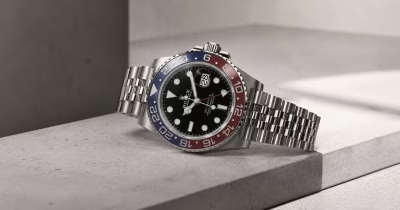
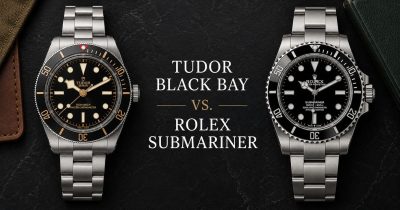
Also, remember that your dive watch does not have to be a “giant lump of steel that only works over a wetsuit”. The best dive watches work just as well with a t-shirt and jeans as they do with a wetsuit. Think of the Rolex Submariner, the Omega Seamaster, or any number of Seiko dive watches—all are equally at home in the office, at dinner, or underwater.
The Strap Matters
The strap or bracelet on your dive watch is more important than many beginners realize. Rubber and silicone straps are lightweight, comfortable, and naturally water-resistant—ideal for actual diving and hot weather. NATO straps are woven nylon straps that pass completely under the watch case, providing security even if a spring bar fails. Metal bracelets offer durability and a more refined look for everyday wear.
Many dive watches come on metal bracelets with a divers’ extension—a folding mechanism that allows the bracelet to expand to fit over a wetsuit. This is a nice feature even if you never plan to wear a wetsuit, as it provides extra adjustability on hot days when your wrist expands.
Beyond the Specs: What Makes a Great First Dive Watch
A good first dive watch should be easy to wear, easy to trust, and easy to understand. It should have real water resistance, strong legibility, a reliable movement, and enough design personality to help you learn what you actually like.
The best first dive watch is not necessarily the cheapest watch with a rotating bezel. It should be wearable, have character, remain technically understandable, and convince in everyday life. It should work as an everyday watch and still feel interesting after the first few weeks of ownership.
What you do not need is a helium escape valve (used for saturation diving at extreme depths), a 1000-meter depth rating, or a movement with a power reserve measured in weeks. These are features for specialists. For your first dive watch, focus on the fundamentals.