- A. Lange & Söhne Watches
- Audemars Piguet Watches
- Bell & Ross Watches
- Blancpain Watches
- Breguet Watches
- Breitling Watches
- Bvlgari Watches
- Cartier Watches
- Chopard Watches
- F.P.Journe Watches
- Franck Muller Watches
- Girard Perregaux Watches
- Glashütte Original Watches
- Hamilton Watches
- Hublot Watches
- IWC Watches
- Jaeger-LeCoultre Watches
- Longines Watches
- Mido Watches
- Nomos Watches
- Omega Watches
- Oris Watches
- Panerai Watches
- Patek Philppe Watches
- Piaget Watches
- Richard Mille Watches
- Roger Dubuis Watches
- Rolex Watches
- Seiko Watches
- Tag Heuer Watches
- Tissot Watches
- Tudor Watches
- Ulysse Nardin Watches
- Vacheron Constantin Watches
- Zenith Watches


Born from the Deep: The Legendary Story of the Fifty Fathoms
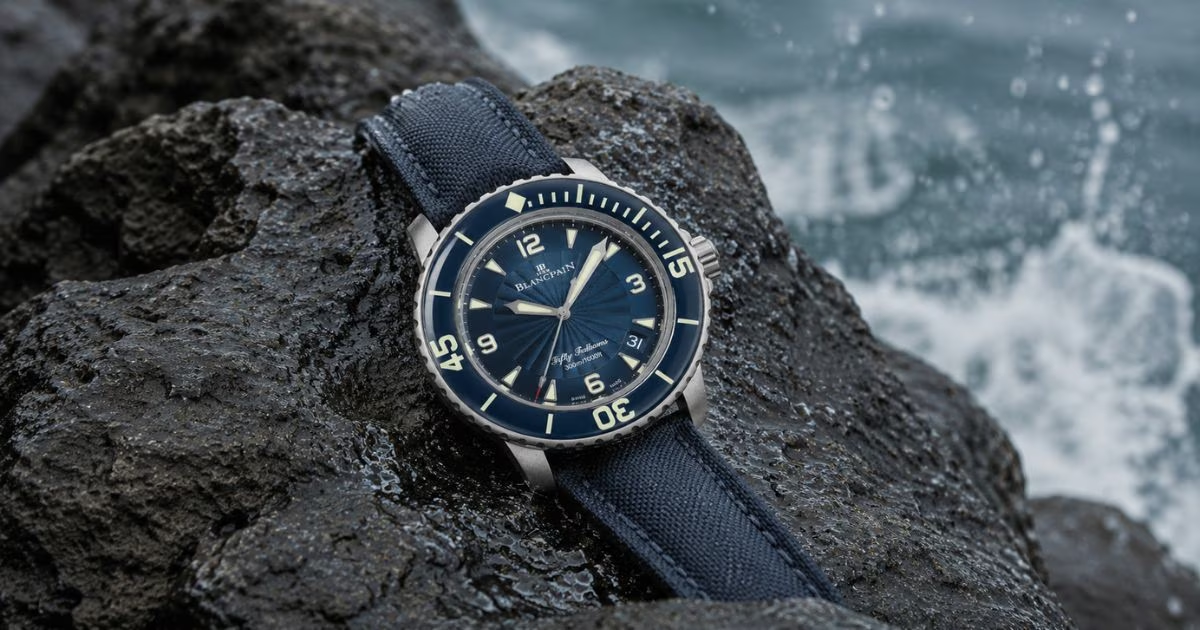
There are few stories in horology as compelling as that of the Blancpain Fifty Fathoms. It is a tale that begins not in a quiet Swiss atelier, but in the murky, high-stakes world of underwater espionage and military innovation. To understand the Fifty Fathoms is to understand the very genesis of the modern dive watch—a tool so perfectly conceived that its fundamental design has remained the blueprint for an entire industry for over seven decades. This is the story of a legend born from the deep.
The Genesis: A Diver’s Necessity
The year is 1952. The Cold War is at its peak, and the French Navy is establishing a new elite combat diving corps. Two of its commanding officers, Captain Robert “Bob” Maloubier and Lieutenant Claude Riffaud, were tasked with a critical mission: find a reliable timepiece for their underwater operatives. Their search, however, was a failure. The watches available on the market were too fragile, too small, and, most critically, prone to leaking under pressure.
So, Maloubier and Riffaud took matters into their own hands. They sat down with a drawing pad and pencil and sketched the specifications for the ideal dive watch: a water-resistant case, a black dial with large, luminous numerals for maximum legibility in dark waters, and an external rotating bezel to track crucial dive times. Armed with this blueprint, they approached a small watch manufacturer in Villeret, Switzerland, named Blancpain.
The Visionary: Jean-Jacques Fiechter
Fate, it seems, had other plans. The CEO of Blancpain at the time was Jean-Jacques Fiechter, an avid and experienced sports diver himself. Unlike other watchmakers who might have dismissed the request, Fiechter understood the challenge intimately. His personal passion for diving gave him a unique insight into the demands of the underwater world.
Fiechter poured his own diving experiences into the development of the watch. In 1953, the result was presented to the world: the Fifty Fathoms. Its name was inspired by Ariel’s song from Shakespeare’s The Tempest—”Full fathom five thy father lies”—a poetic nod to the depths it was designed to conquer. It was hailed as the world’s first true modern diver’s watch .
A Revolution in the Deep
The Fifty Fathoms was not just a new watch; it was a catalogue of innovations that would define the dive watch category for generations. It was a tool, not a trinket, and its features were a direct response to the dangers of diving.
First and foremost was its water resistance of fifty fathoms, or approximately 91.5 meters, which was considered the maximum safe depth for a diver at the time. To achieve this, Fiechter introduced several ingenious patents. He developed a double-sealed crown system and a screwed caseback that featured a unique metallic ring to protect the critical O-ring seal from friction, ensuring its integrity.
Perhaps its most iconic feature was the rotating bezel. To time a dive, the diver aligns the bezel’s zero marker with the minute hand. As time passes, the minute hand moves along the bezel’s scale, showing exactly how long the diver has been submerged. This system is now the universal standard for dive watches. Crucially, Fiechter’s version featured a locking mechanism to prevent accidental rotation, a potentially fatal error for a diver. The watch was also fitted with an automatic movement—a choice driven by logic, not just convenience. Fiechter knew that the crown was the most vulnerable point for water ingress, and an automatic movement meant the crown would not need to be wound manually, reducing wear and tear and the risk of user error.
A Military Pedigree and Hollywood Fame
The French Navy quickly adopted the Fifty Fathoms, with the official Spirotechnique network distributing these early models. Its reputation for reliability and durability soon spread far beyond France.
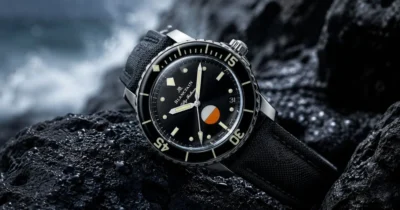
In the United States, the watch faced a hurdle: the “Buy American Act” required the US government to favor American-made products. To circumvent this, the Fifty Fathoms was rebranded and distributed by a company called Tornek-Rayville, making it eligible for military contracts. The “Milspec 1” version became the standard-issue dive watch for the US Navy Seals and other elite units. It even featured a hemispheric moisture indicator on the dial—a small window that would turn from white to red if moisture entered the case, warning the diver of a potential failure.
The watch’s legend was further cemented by its association with the most famous undersea explorer of all time, Jacques-Yves Cousteau. His team wore the Fifty Fathoms while filming the groundbreaking documentary Le Monde du Silence (The Silent World), which won the Palme d’Or at Cannes and an Academy Award in 1957. It was the ultimate validation: the world’s most demanding underwater professionals had chosen the Fifty Fathoms.
The Evolution of a Legend
Throughout the 1960s and 1970s, the Fifty Fathoms continued to evolve while maintaining its core identity. One of the most significant developments was the “No Rad” dial. As the dangers of radium, the radioactive material used for lume, became widely known, Blancpain switched to the safer tritium. To reassure its military and civilian clients, the brand introduced a distinctive symbol at 6 o’clock: a yellow and red circle with a black cross, accompanied by the words “No Radiation”.
The Fifty Fathoms also served navies worldwide, with special versions created for the German Bundesmarine and other forces. These models, like the “Barracuda,” often featured a “3H” symbol, indicating the use of tritium.
Rebirth and Modern Mastery
Despite its illustrious history, the Fifty Fathoms’ production waned in the 1980s. Its renaissance began in 2003 when the company’s new CEO, Marc A. Hayek—himself a passionate diver—made it his mission to “bring back alive” this legendary history.
In 2003, a limited-edition 50th-anniversary model was released, and in 2007, the Fifty Fathoms was permanently re-established as a cornerstone of the Blancpain collection. This new generation featured a masterpiece of engineering: the in-house Caliber 1315. This automatic movement boasted three mainspring barrels, providing a remarkable five-day power reserve, and a silicon balance spring for superior anti-magnetism and shock resistance. The iconic bezel was also reimagined, with a scratch-proof sapphire insert replacing the older Bakelite version.
The collection has since expanded to include the more elegant Bathyscaphe line, which offers a slightly smaller and more refined alternative, and pioneering technical marvels like the Tech Gombessa, designed for extreme long-duration dives.
Today, the Fifty Fathoms stands not just as a historical artifact but as a living collection that continues to push the boundaries of watchmaking. Whether it’s a modern titanium model or a red-gold version, every piece carries the soul of its 1953 ancestor. It is a testament to the fact that when a tool is designed with absolute purpose and uncompromising integrity, it transcends its function to become a true icon.
From the clandestine missions of the Cold War to the silver screen, the Fifty Fathoms is more than a watch. It is the very embodiment of the spirit of exploration. It is a legend, forever born from the deep.



Related posts
Born from the Deep: The Legendary Story of the Fifty Fathoms
There are few stories in horol...
Chronometer vs. Chronograph: Finally Knowing the Difference
We use a lot of jargon in the ...
Tudor Black Bay vs. Rolex Submariner: The Value Proposition
Few watch comparisons generate...

Why Watch Collectors Choose Tatokoo to Sell Their Timepieces
Selling a luxury watch is rare...


From First Watch to Dream Collection: Your Journey with Tatokoo
Luxury watch collecting is mor...
The Ultimate Beginner’s Guide to Vintage Watch Collecting
There comes a moment in every ...
The Tribute to Fifty Fathoms MIL-SPEC: A Nod to History
There are certain watches that...
Summer Strap Guide: Stay Cool and Stylish in the Heat
There’s a moment every summer ...