
Tudor Black Bay vs Rolex Submariner: The Value Proposition
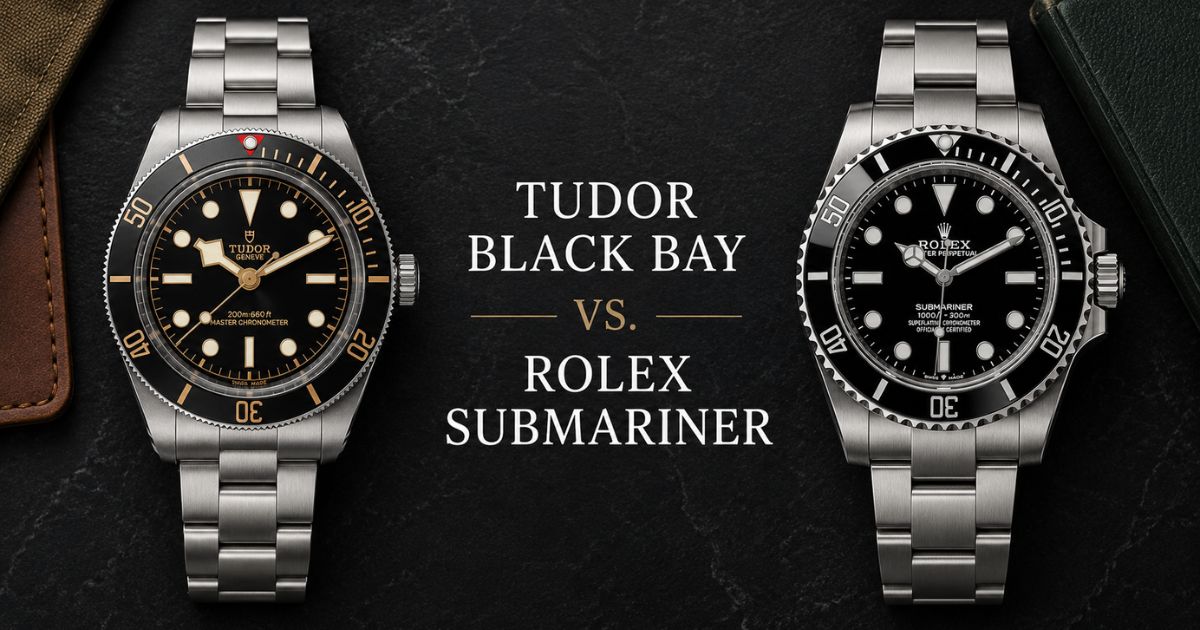
Few watch comparisons generate as much passionate debate as the Tudor Black Bay versus the Rolex Submariner. They share DNA, heritage, and even family ties—yet they serve profoundly different collectors. One is a modern luxury icon, universally recognized and culturally embedded. The other has quietly become arguably the best-value dive watch on the market, offering enthusiasts a compelling alternative that stands on its own merits.
But what does “value” really mean in this context? For some, value is about prestige and enduring worth. For others, it is about the ratio of experience to investment, or the freedom to wear a watch without reservation. This article examines the Black Bay and Submariner through the lens of value—not in monetary terms, but in what each watch offers to the collector who wears it.
Shared DNA, Divergent Paths
The story of the Submariner and the Black Bay begins with the same man. Hans Wilsdorf, the founder of Rolex, created Tudor in 1926 with a clear mission: to offer Rolex-level reliability and build quality at a more accessible price point. For decades, Tudor divers used Rolex-signed crowns, cases, and even bracelets. Vintage Tudor Submariners from the 1960s and 1970s are a testament to this shared lineage—Rolex cases with Tudor-signed dials and movements sourced from third-party makers.
That relationship began to shift in the 2010s. When Tudor launched the Heritage Black Bay in 2012, it marked the beginning of a new chapter. Rather than simply rebadging Rolex components, Tudor leaned into its own identity, drawing design cues from its archived dive watches while developing in-house movements. Today, the two brands share a parent company but occupy very different positions in the market. The Black Bay has evolved from a budget alternative into a legitimate rival—a watch that commands respect not because of its relation to Rolex, but because of what it delivers on its own.
Design Philosophy: Heritage vs. Evolution
The Submariner, introduced in 1953, helped define what a dive watch should be—and it still sets the standard today. Instantly recognizable, universally respected, it has evolved conservatively over decades. Rolex refines rather than revolutionizes. The current-generation Submariner features a clean, balanced profile, a modern ceramic bezel, and a slimmer silhouette that transitions effortlessly from wetsuit to suit. It is a watch designed to be timeless, not trendy.
The Black Bay embraces a different philosophy. It leans into vintage cues while offering modern performance. The snowflake hands, domed crystal, and unidirectional aluminum bezel are design constants across the line. The case is thicker, the proportions more intentional—a tool-watch presence that feels rugged, purposeful, and slightly more casual. Tudor allows itself more design experimentation than Rolex would permit. The result is a watch that appeals to collectors who want personality and value rather than status alone.
The Black Bay 58, at 39mm, marked a return to something approaching the size of genuine Rolex and Tudor dive watches of the 1950s. It offers the look and feel of a vintage Submariner without the headaches that come with vintage mechanics and fragile parts. The Black Bay 54, at 37mm, pushes even further into compact territory, while the 41mm Monochrome offers a more contemporary presence. This range of sizes is itself a form of value—choice that Rolex, with its strict 41mm Submariner, simply does not offer.
Materials and Craftmanship
The Submariner uses Rolex’s proprietary 904L Oystersteel, an alloy that is harder to machine and more resistant to corrosion and pitting than the 316L stainless steel found in most of the watch industry—including the Tudor Black Bay. The ceramic Cerachrom bezel is virtually scratch-proof and fade-resistant. These are not trivial differences; they represent Rolex’s commitment to absolute longevity and refinement.
The Black Bay, by contrast, uses 316L steel and traditional aluminum bezel inserts. This is not a compromise in quality—316L is the industry standard for a reason—but it does represent a different philosophy. The aluminum bezel will age and potentially fade over time, acquiring the patina that vintage enthusiasts cherish. Where Rolex aims for permanence, Tudor embraces the character that comes with wear.
Yet Tudor has not stood still. The Black Bay 58 925, launched in 2021, brought sterling silver back to mainstream watchmaking for the first time in over 80 years. The Black Bay Ceramic pushed into new material territory entirely. And across the line, Tudor has refined its case finishing with brushed sides and polished bevels that rival watches at significantly higher price points.
The Movement Question
For decades, the distinction between Rolex and Tudor was clear: Rolex used in-house chronometer-certified movements, while Tudor used off-the-shelf ETA movements. That distinction has blurred significantly.
Today’s Rolex Submariner runs on the in-house caliber 3230 (no-date) or 3235 (date), featuring Rolex’s Superlative Chronometer standard of -2/+2 seconds per day, tested after casing. These movements are engineered for decades of use with minimal fuss.
Tudor’s in-house MT series movements, developed through its partnership with Kenissi, are COSC-certified and offer a 70-hour power reserve. More significantly, many of the current Black Bay models now run METAS-certified Master Chronometer movements, placing Tudor on the same testing standard as Omega’s top-tier divers. The 2026 Black Bay 58 Master Chronometer represents a watershed moment: Tudor now offers precision and reliability that stands toe-to-toe with its lauded sibling.
The Wearing Experience
On the wrist, these watches feel fundamentally different. The Submariner is slimmer—approximately 13mm thick compared to the Black Bay’s 13.6mm—and its 48mm lug-to-lug measurement sits more compactly than the Black Bay’s 50mm. The Submariner’s Glidelock clasp allows tool-free micro-adjustment by a few millimeters. It is a watch that feels polished, refined, and deliberate in every detail.
The Black Bay wears larger and taller. Some will prefer this—it feels more like a tool watch, more substantial, more intentional in its presence. Others will find the Submariner’s thinner profile more comfortable for daily wear. The T-Fit micro-adjustment clasp, now standard across the Black Bay line, brings a level of on-the-fly adjustability that was once the exclusive domain of Rolex.
There is also the question of how you wear it. The Black Bay truly thrives off-bracelet—woven nylon straps evoke heritage military diving, sailcloth suits daily wear, rubber modernizes, and leather adds vintage warmth. The Submariner works on straps too, but many owners keep it on the bracelet. The Black Bay invites creativity; the Submariner commands respect.
The Value Proposition Defined
So what is the value proposition of each?
The Submariner offers the intangible: the weight of history, the cultural power of the world’s most celebrated dive watch, and a level of craftsmanship and finishing that represents the pinnacle of industrial watchmaking. It is a watch that holds its value with remarkable consistency, one of the few true “blue-chip” assets in the watch world. For collectors who value prestige, tradition, and the assurance of owning a piece of horological history, the Submariner delivers.
The Black Bay offers something different: progressive engineering, fresh reliability, and accessible luxury with a compelling history. For many collectors, it delivers 80 to 90 percent of the Submariner experience. It is a watch that can be worn daily without the financial pressure to “baby” it. It invites experimentation with straps and styles. It represents a philosophy of collecting that values design and personality over status.
Tudor has worked hard to shed the “poor man’s Rolex” label. The Black Bay is not a substitute—it is a distinct proposition with its own identity, its own heritage, and its own passionate following. The fact that it shares DNA with the Submariner only heightens its appeal; being in the Rolex orbit underscores the value proposition that a Black Bay brings to the table.
Final Thoughts
There is no wrong choice here—only different priorities. The Rolex Submariner is the icon everyone knows. The Tudor Black Bay is the enthusiast’s diver that invites creativity.
Choose the Submariner if you want the ultimate luxury dive watch, if brand recognition matters to you, if you value long-term collectibility, and if you prefer a refined, timeless aesthetic. Choose the Black Bay if you want maximum value, if you enjoy customization and strap swaps, if you prefer a more rugged tool-watch feel, and if you are a true enthusiast who values design over status.
Both watches represent the best of their respective philosophies. One is a monument to consistency and prestige. The other is a testament to what happens when a brand is given the freedom to innovate within a storied lineage. In the end, the real value is not in the watch itself—it is in how it fits your wrist, your lifestyle, and your sense of what a watch should be.