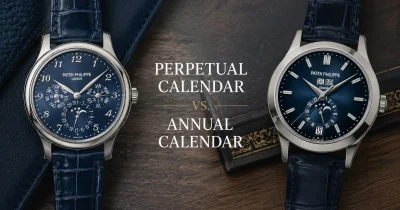

Perpetual Calendar vs. Annual Calendar: What’s the Difference?
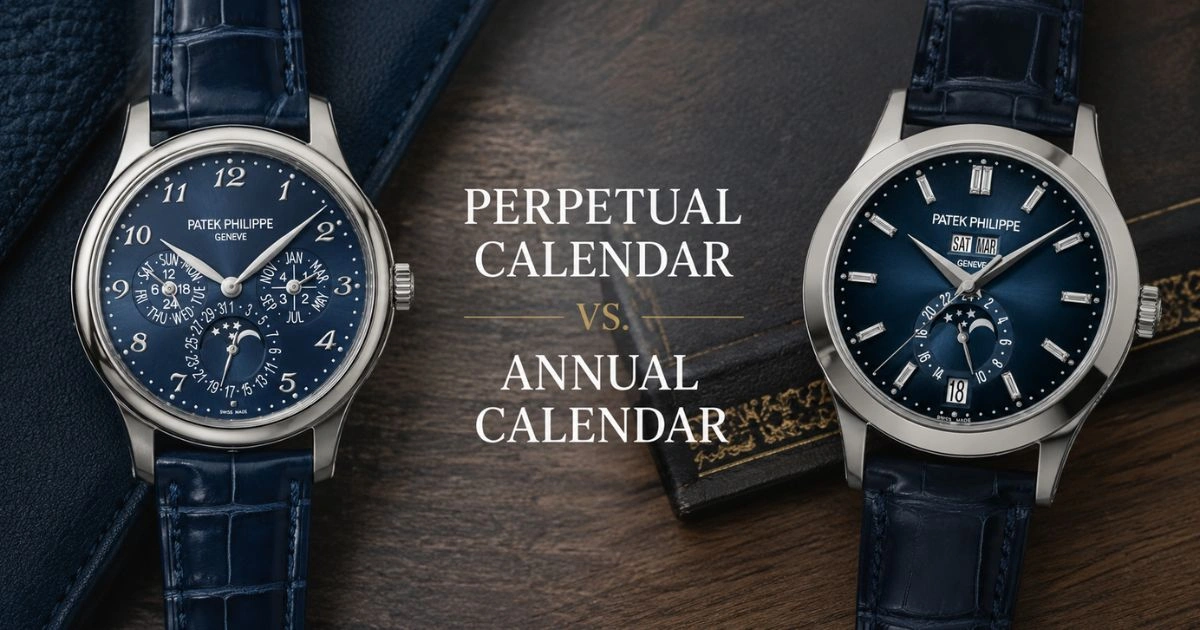
In the world of haute horlogerie, few complications capture the imagination quite like a sophisticated calendar mechanism. They represent a fascinating intersection of astronomy, mechanical engineering, and human ingenuity. For the uninitiated, however, the terminology can be daunting. Two terms that often cause confusion are “Annual Calendar” and “Perpetual Calendar.” While they may appear similar at a glance, they represent distinctly different levels of mechanical complexity and convenience.
This guide will demystify these two complications, exploring their history, inner workings, and what sets them apart.
The Challenge of the Gregorian Calendar
Before we delve into the watches themselves, it’s crucial to understand the problem they are designed to solve. The Gregorian calendar, which we use today, is wonderfully logical except for one significant issue: it’s highly irregular. Months have varying lengths (28, 29, 30, or 31 days), and there’s the added complexity of leap years. For a standard mechanical watch with a simple date wheel, this means it assumes every month has 31 days. Consequently, the wearer must manually correct the date five times a year—after every month with fewer than 31 days.
The need to solve this “inconvenience” spurred watchmakers to create ever more intelligent calendar mechanisms. The annual and perpetual calendars are the two most sophisticated results of this pursuit.
The Annual Calendar: Practical Genius
The annual calendar complication, in the grand timeline of watchmaking, is a relatively recent innovation. It was first introduced by Patek Philippe in 1996 with the reference 5035. Its creation was a masterstroke in balancing practicality with mechanical complexity.
How It Works
An annual calendar is a mechanism designed to automatically distinguish between months with 30 and 31 days. It achieves this through a clever system of rotating wheels with differently shaped teeth. The month wheel, for instance, has specific teeth that signal the calendar mechanism to skip the 31st day for the shorter months. This allows the watch to flawlessly keep track of the date for the vast majority of the year without any intervention from the wearer.
The “One Catch”
So, what’s the catch? The annual calendar cannot account for the unique case of February. It is programmed to have 30 or 31 days, and since February has either 28 or 29, the mechanism “gets confused” and will switch from February 28 (or 29) directly to March 1, effectively skipping days. This means the watch requires a single, manual adjustment at the end of February each year to set it correctly for the first of March.
The Appeal
The annual calendar is highly prized for being incredibly practical. It offers the convenience of a near-automatic calendar without the significantly higher cost and complexity of a perpetual calendar. It is often seen as the perfect “everyday” complication—a useful and robust feature that enhances the wearer’s experience without demanding excessive attention . Brands like Cartier, Montblanc, and Glashütte Original produce notable examples.
The Perpetual Calendar: The “Mechanical Brain”
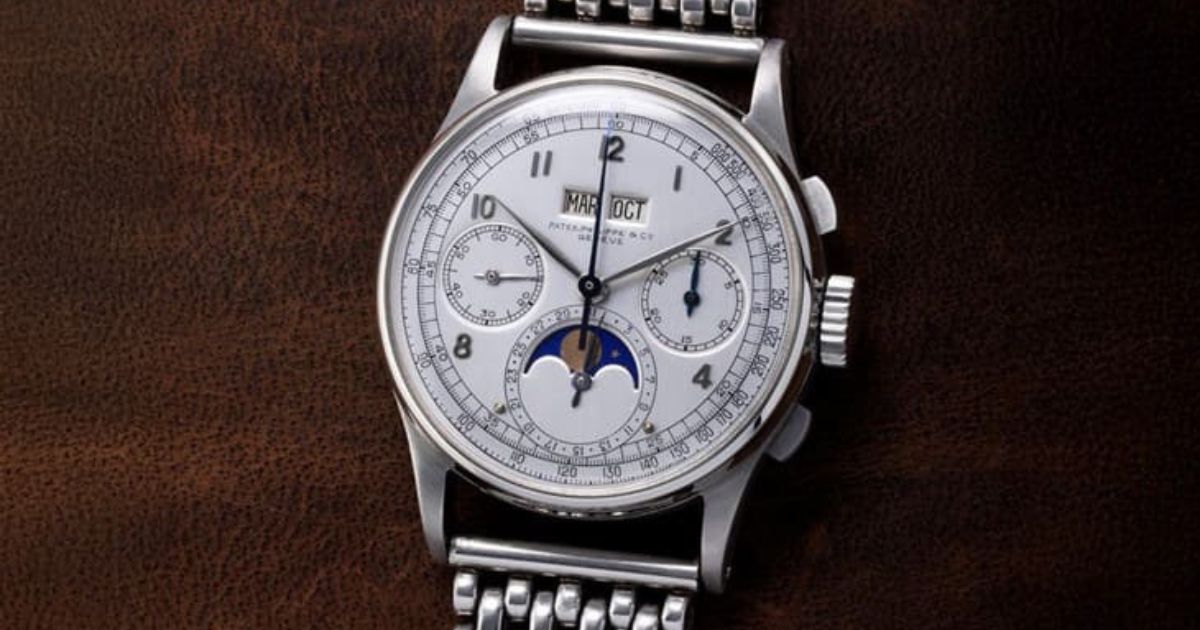
The perpetual calendar is the grand master of calendar complications. While an annual calendar is smart, a perpetual calendar is a “mechanical brain.” This complication has a much deeper history, with the first known perpetual calendar pocket watches dating back to the 18th century, created by master watchmakers like Thomas Mudge. Patek Philippe brought this complication to the wrist in 1925.
How It Works
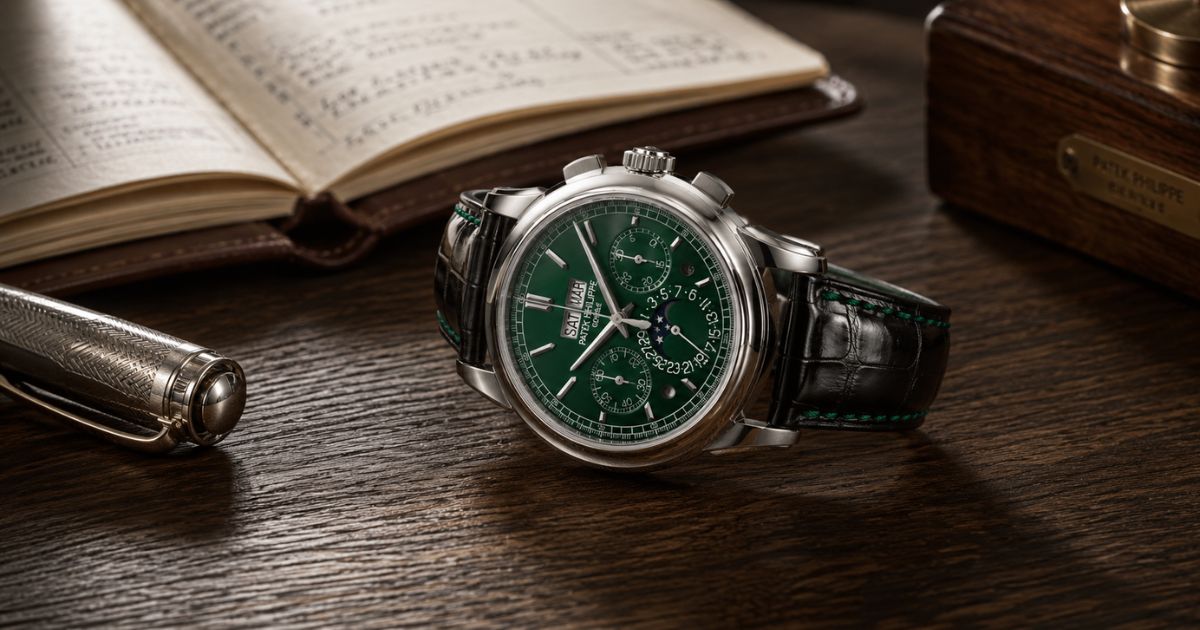
The key differentiator is that a perpetual calendar is programmed to account for leap years. It features a complex system of cams and levers, often including a 48-month (or four-year) wheel, that “remembers” the leap-year cycle. This intricate system allows it to automatically and correctly transition from February 28 to February 29 on a leap year, and from February 29 to March 1 the following year. It accurately tracks the day, date, month, and often the year and moonphase, with no need for manual adjustments.
The Century Exception
Perpetual calendars are often said to be accurate “until the year 2100.” This is not because of a flaw, but due to a quirk in the Gregorian calendar itself. While a leap year occurs every four years, there is an exception for century years. The year 2100 will not be a leap year, as it is not divisible by 400 . A standard perpetual calendar, programmed for the four-year cycle, will still register 2100 as a leap year, meaning it will need to be manually corrected on March 1 of that year. Some watchmakers, like IWC, have created “secular” perpetual calendars that can account for this rule and remain accurate for centuries.
The Appeal
The perpetual calendar is considered one of the three “grand complications” in watchmaking, alongside the minute repeater and the chronograph. It is a testament to the absolute pinnacle of mechanical artistry and engineering. For a collector, owning a perpetual calendar is not just about having a useful tool; it’s about possessing a miniature universe that mirrors the heavens with poetic precision. However, they are considerably more complex, fragile, and expensive to produce than annual calendars, requiring a deep appreciation for the craft.
The Head-to-Head Summary
To make the distinction crystal clear, here is a direct comparison:
| Feature | Annual Calendar | Perpetual Calendar |
|---|---|---|
| Automatic Adjustment | For months with 30 or 31 days. | For all month lengths, including February’s 28/29 days. |
| Leap Year Recognition | No. | Yes. |
| Manual Adjustment | Once a year (at the end of February). | Not until the year 2100 (due to the Gregorian calendar exception). |
| Mechanical Complexity | Highly complex, but a simpler system than a perpetual. | Extremely complex; a pinnacle of mechanical engineering. |
| History | First wristwatch introduced in 1996 by Patek Philippe. | First wristwatch created in 1925 by Patek Philippe; roots in 18th-century pocket watches. |
Conclusion
Choosing between an annual and a perpetual calendar is a decision of philosophy and preference as much as it is about mechanics. The annual calendar is a brilliant, practical complication that offers a taste of high-horology with exceptional convenience and reliability. It is a true “watchmaker’s complication” that enhances the experience of wearing a fine watch every day.
The perpetual calendar, on the other hand, is an heirloom. It is a profound technical achievement that represents the watchmaker’s art at its highest level. It is a statement of permanence, a mechanical connection to the cosmos that will keep perfect track of time for decades, needing only a rare moment of human intervention. Whether you admire the ingenious simplicity of the annual or the breathtaking complexity of the perpetual, both complications are stunning reminders of the human desire to master time itself.