
The Top 10 Perpetual Calendar Watches of All Time
Few complications in haute horlogerie command the same reverence as the perpetual calendar. Often referred to as the quantième perpétuel or simply “QP,” this mechanical marvel does more than tell time—it thinks. It understands that February has 28 days, except when it has 29. It knows that some months have 30 days and others 31. And it remembers all of this, year after year, without intervention from its wearer.
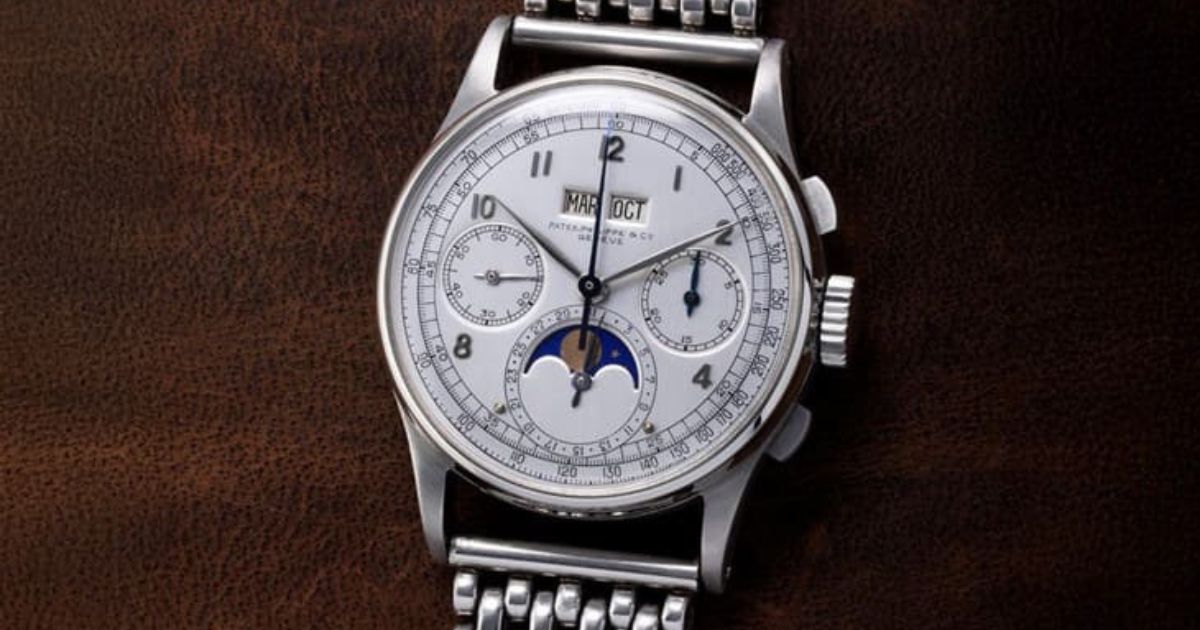
The perpetual calendar traces its origins to 1762, when English horologist Thomas Mudge first introduced the concept. It would take another 163 years before the complication found its way onto the wrist, thanks to Patek Philippe. Since then, the perpetual calendar has become one of the crown jewels of watchmaking—a testament to human ingenuity, mechanical artistry, and our enduring fascination with taming time itself.
Today, we celebrate the ten greatest perpetual calendar wristwatches ever created. These are the watches that defined the complication, pushed its boundaries, and continue to inspire collectors and connoisseurs around the world.
1. IWC Da Vinci Perpetual Calendar Chronograph (Kurt Klaus, 1985)
No list of great perpetual calendars would be complete without acknowledging the genius of Kurt Klaus. In 1985, IWC presented the Da Vinci, an automatic chronograph with perpetual calendar that became one of the most historic perpetual calendars of all time. What made it truly revolutionary was that it was the world’s first perpetual calendar mechanism in which all indications could be adjusted solely via the crown. Prior to this, adjusting a perpetual calendar required multiple pushers and correctors scattered across the case. Klaus’s invention transformed the complication from a finicky curiosity into something genuinely wearable. The Da Vinci’s modular architecture and crown-only adjustment set a template that many brands still follow today, and its influence on modern perpetual calendar design cannot be overstated.
2. Frederique Constant Classic Perpetual Calendar Manufacture
If there is one watch that democratised the perpetual calendar, it is this one. Frederique Constant achieved what many thought impossible: a mechanical perpetual calendar wristwatch priced under $10,000. The Classic Perpetual Calendar Manufacture delivers everything a collector could want—date, day, month, leap year, and moonphase—in a classically proportioned, elegantly finished package. With its radially brushed salmon dial and slimline case, it looks every bit as refined as perpetual calendars costing five times as much. Frederique Constant developed the perpetual calendar module entirely in-house, proving that high complications need not be the exclusive domain of the ultra-wealthy. For anyone seeking entry into the world of perpetual calendars, this is the gateway.
3. Bulgari Octo Finissimo Perpetual Calendar
When Bulgari introduced the Octo Finissimo Perpetual Calendar in 2021, it shattered records. At just 5.8mm thick with a 40mm titanium case, it became the world’s thinnest perpetual calendar watch. The achievement is all the more remarkable given that the watch features a retrograde date display, day and month indicators, and a leap-year indicator—all arranged across a beautifully sandblasted dial. Powering this marvel is the automatic micro-rotor Caliber BVL 305, a movement that remains as impressive today as when it was first unveiled. The Octo Finissimo proves that ultra-thin and highly complicated need not be mutually exclusive, and its angular, architectural design has become one of the most distinctive expressions of the perpetual calendar in modern watchmaking.
4. Audemars Piguet Royal Oak Perpetual Calendar
Audemars Piguet’s history with the perpetual calendar runs deep—the maison created the world’s first perpetual calendar wristwatch with a leap-year indicator in 1955, and in 1978, it debuted the Calibre 2120/2800, the world’s thinnest automatic perpetual calendar wristwatch movement. But it is the Royal Oak Perpetual Calendar that has become the definitive expression of AP’s mastery. First introduced in the 1980s, it married Gerald Genta’s iconic octagonal design with one of watchmaking’s most revered complications. The Royal Oak’s integrated bracelet, distinctive bezel, and “Tapisserie” dial provide the perfect canvas for the perpetual calendar’s sub-dials. In recent years, Audemars Piguet has refined the formula further, introducing 38mm versions with revolutionary “all-in-one” crown adjustment. The Royal Oak Perpetual Calendar is not just a watch—it is a cultural icon.