- A. Lange & Söhne Watches
- Audemars Piguet Watches
- Bell & Ross Watches
- Blancpain Watches
- Breguet Watches
- Breitling Watches
- Bvlgari Watches
- Cartier Watches
- Chopard Watches
- F.P.Journe Watches
- Franck Muller Watches
- Girard Perregaux Watches
- Glashütte Original Watches
- Hamilton Watches
- Hublot Watches
- IWC Watches
- Jaeger-LeCoultre Watches
- Longines Watches
- Mido Watches
- Nomos Watches
- Omega Watches
- Oris Watches
- Panerai Watches
- Patek Philppe Watches
- Piaget Watches
- Richard Mille Watches
- Roger Dubuis Watches
- Rolex Watches
- Seiko Watches
- Tag Heuer Watches
- Tissot Watches
- Tudor Watches
- Ulysse Nardin Watches
- Vacheron Constantin Watches
- Zenith Watches


Chronometer vs. Chronograph: Finally Knowing the Difference
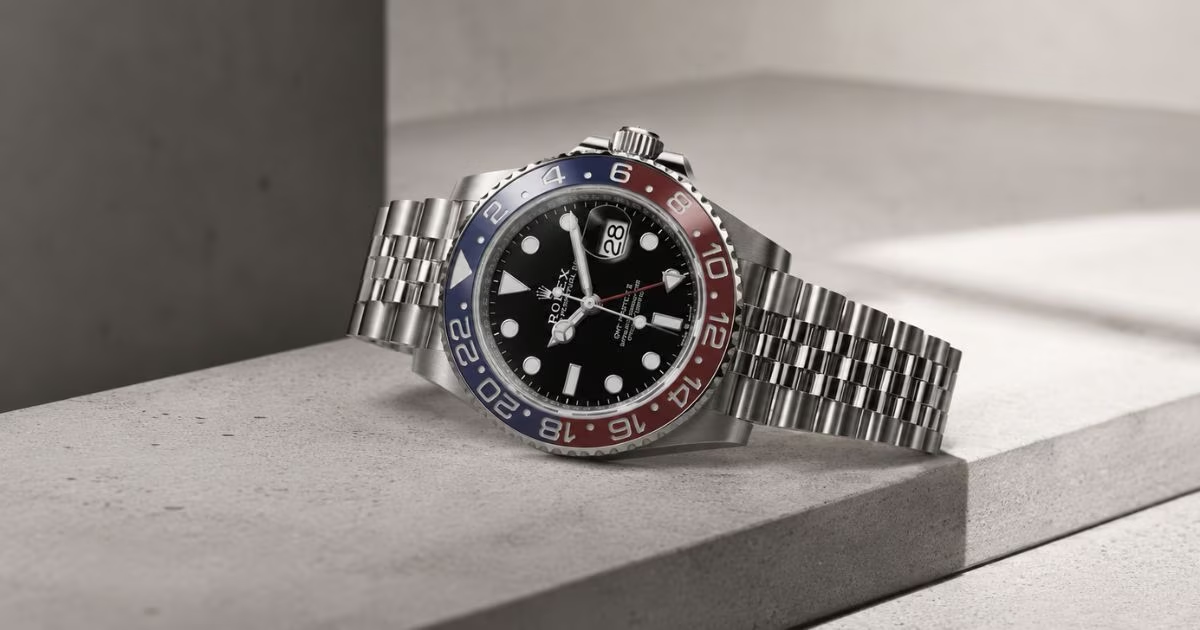
We use a lot of jargon in the world of luxury watches. It can feel like learning a new language. Two terms that constantly trip people up are “chronometer” and “chronograph”. They sound similar, they both have “chrono” in them, and they both have something to do with time. So, are they the same thing? Absolutely not.
The confusion is completely understandable. Even seasoned collectors sometimes struggle to explain the difference. But the distinction is actually quite simple once you break it down. In essence, one is a measure of a watch’s quality, and the other is a measure of its functionality . Let’s get into it.
The Chronograph: The “Time Writer”
Let’s start with the chronograph. The word comes from the Greek khronos (time) and grapho (to write). So, a chronograph literally means “time writer”. The name is a nod to the earliest examples of the complication, which used a small pen to record elapsed time on a rotating paper disc.
In modern terms, a chronograph is a stopwatch built into your watch. It’s a complication. In horology, a complication is any extra feature on a watch that goes beyond simply displaying the hours, minutes, and seconds. This makes a chronograph a very useful and interactive feature.
How to Spot a Chronograph
You can usually identify a chronograph by a few key visual cues:
- Pushers: The most obvious feature is a pair of pushers on the side of the case, flanking the winding crown. Typically, the top pusher starts and stops the timing function, and the bottom pusher resets it to zero.
- Subdials: Chronograph watches almost always have smaller subdials on the main dial. These are called “totalizers” or “registers.” They track the elapsed time measured by the chronograph, usually in 30-minute and 12-hour increments, in addition to the watch’s main running seconds.
- A Central Chronograph Hand: There is a dedicated, centrally-mounted seconds hand for the chronograph. This hand remains motionless at zero when the chronograph isn’t in use. It only begins to sweep when you press the start pusher.
Beyond the standard chronograph, you’ll also find more complex variations like the flyback chronograph (which can be reset and restarted with a single push) and the rattrapante or split-seconds chronograph (which can time two events simultaneously).
The Chronometer: The “Time Measurer”
The term “chronometer” also has Greek roots: chronos (time) and metron (measure). It translates to “time measurer”. It sounds similar to a chronograph, but its meaning is entirely different. A chronometer is not a complication or a function. Instead, it’s a certification of precision and accuracy.
A chronometer is a watch that has undergone rigorous testing by an official, independent body and has proven its ability to keep time with exceptional accuracy. The most recognized certifying institution for Swiss watches is the Contrôle Officiel Suisse des Chronomètres, or COSC.
The COSC Standard
To earn the title of “Chronometer,” a watch movement must pass a series of tests over 15 consecutive days. It’s a grueling process:
- Testing Conditions: The movements are tested in five different positions and at three different temperatures (8°C, 23°C, and 38°C) to simulate real-world wearing conditions.
- Seven Criteria: The movement must meet seven strict criteria to be certified. The most famous of these is the average daily rate, which must fall between -4 and +6 seconds per day. This means a certified chronometer will lose no more than 4 seconds, or gain no more than 6 seconds, in a 24-hour period.
If a movement meets these standards, the watch is allowed to be called a chronometer, and you will usually see the word proudly printed on its dial. Only about 3% of all Swiss watches made are COSC-certified, making it a mark of significant achievement.
The Ultimate Clarification: Can a Watch Be Both?
This is where the final piece of the puzzle clicks into place. A watch can be both a chronograph and a chronometer at the same time. These two terms are not mutually exclusive.
Think of it this way: A chronograph is a function (the stopwatch). A chronometer is a stamp of quality (the accuracy certification).
- Example 1: The classic Rolex Daytona is a chronograph (it has a stopwatch function) and it is also a COSC-certified chronometer (it is highly accurate).
- Example 2: An Omega Speedmaster is a chronograph. Many Speedmaster models are also certified chronometers, and some go even further to be Master Chronometers certified by METAS (Swiss Federal Institute of Metrology), which imposes even stricter accuracy standards.
It’s important to note that while a chronograph can be a chronometer, most chronographs are not. The chronograph complication adds complexity and expense, but the precision of that complication is not tested by the COSC, only the precision of the watch’s timekeeping function.
Conclusion: A Simple Distinction
The easiest way to remember the difference is this:
- Chronograph = Function. It tells you how long something took. It’s a stopwatch.
- Chronometer = Quality. It tells you the time extremely accurately. It’s a certified precision timekeeper.
One is a feature you can use; the other is a seal of approval. So, next time you hear these two terms in conversation or see them on a watch dial, you can confidently explain the difference and you’ll know exactly what they mean.



Related posts
Born from the Deep: The Legendary Story of the Fifty Fathoms
There are few stories in horol...
Chronometer vs. Chronograph: Finally Knowing the Difference
We use a lot of jargon in the ...
Tudor Black Bay vs. Rolex Submariner: The Value Proposition
Few watch comparisons generate...
Why Watch Collectors Choose Tatokoo to Sell Their Timepieces
Selling a luxury watch is rare...
From First Watch to Dream Collection: Your Journey with Tatokoo
Luxury watch collecting is mor...
The Ultimate Beginner’s Guide to Vintage Watch Collecting
There comes a moment in every ...
The Tribute to Fifty Fathoms MIL-SPEC: A Nod to History
There are certain watches that...
Summer Strap Guide: Stay Cool and Stylish in the Heat
There’s a moment every summer ...