
A Crown For The Ages: The Complete History of Rolex
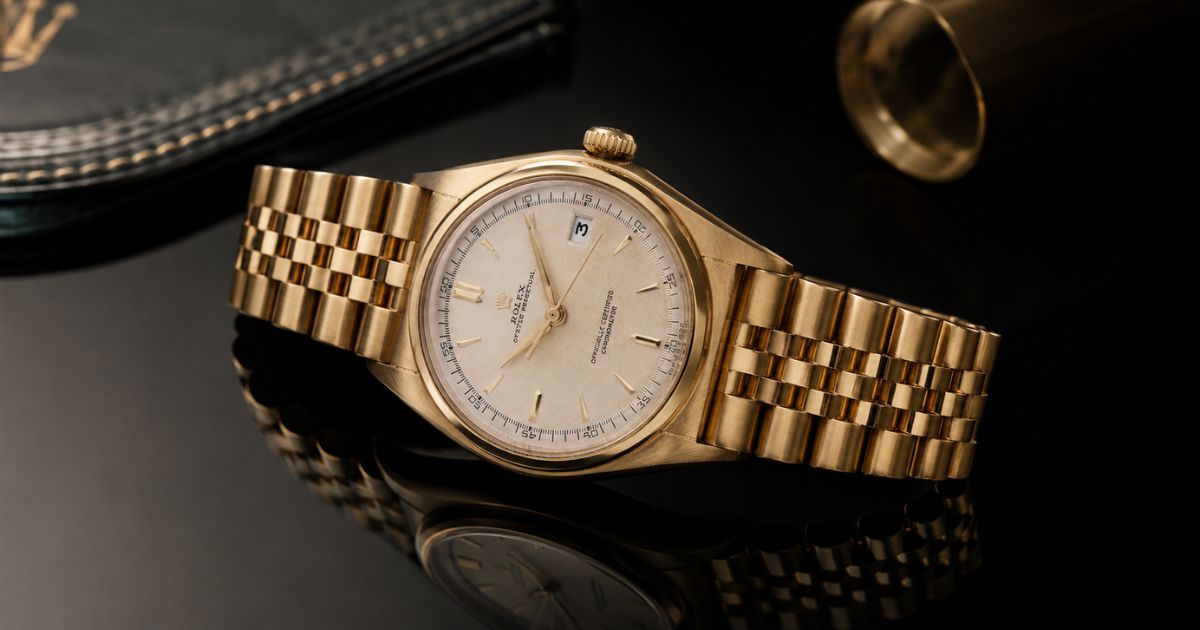
If you look down at your wrist right now, chances are the watch staring back at you owes a debt to the brand we are discussing today. In the world of horology, there is the competition, and then there is The Crown. For over a century, Rolex has transcended its status as a mere watch manufacturer to become a global archetype of achievement, reliability, and prestige.
But how did a brand started by a visionary orphan from Bavaria come to define the modern wristwatch? How did we get from fragile pocket watches to the waterproof Oyster, and eventually to the status symbol of the Submariner and Daytona?
This is the complete history of Rolex.
The Visionary: Hans Wilsdorf
Every empire has its architect, and for Rolex, that man was Hans Wilsdorf. Born in Bavaria in 1881, Wilsdorf was orphaned as a teenager. Despite this hardship, he was fascinated by the fledgling world of timekeeping. In the early 1900s, the pocket watch was king. Wristwatches were considered fragile novelties—”women’s jewelry,” as the market saw it, or simply not robust enough for serious use.
Wilsdorf disagreed profoundly.
In 1905, at just 24 years old, he founded his own company in London (initially named Wilsdorf & Davis) with a singular, radical hypothesis: He believed that the future was on the wrist. He sourced compact, precise movements from a Swiss manufacturer in Bienne and set about proving that a wristwatch could be just as accurate as a pocket watch.
By 1910, he had his proof. A Rolex wristwatch became the first in the world to receive the Swiss Certificate of Chronometric Precision. Four years later, in 1914, a Rolex wristwatch received a “Class A” precision certificate from the Kew Observatory in London—a distinction normally reserved for the massive, high-security marine chronometers used by the Royal Navy. The wristwatch had arrived.
1926: The Birth of the “Oyster”
The 1920s were a decade of transformation. In 1919, seeking favorable export tariffs and a home closer to the Swiss movement makers, Wilsdorf moved the company to Geneva, Switzerland. It is here that the magic truly began.
In 1926, Rolex unveiled the Oyster. This was not just a new watch; it was a completely new way to protect a watch. Wilsdorf introduced the world’s first waterproof and dustproof wristwatch case. The secret was the “crown,” which screwed down onto the case, creating a hermetically sealed environment for the delicate movement inside.
Naming it the “Oyster” evoked the impenetrable nature of an oyster’s shell. It was a marketing masterstroke, but Wilsdorf knew that to sell a waterproof watch, he had to prove it in the most dramatic way possible.
In 1927, a young British swimmer named Mercedes Gleitze set out to swim the English Channel. Wilsdorf gave her an Oyster to wear around her neck. The swim lasted over ten hours in freezing, turbulent water. When Gleitze emerged—famously, she was the first British woman to complete the swim—the Rolex Oyster was still ticking perfectly. Wilsdorf took out a full-page ad on the front page of the Daily Mail proclaiming the success. It was the birth of “Testimonee” marketing, tying the brand indelibly to human triumph.
1931: The Perpetual Revolution
If the Oyster case was the body of modern watchmaking, 1931 provided its heart. Rolex invented and patented the Perpetual rotor.
Before this, automatic watches existed, but they used “bumper” winders that were inefficient and fragile. Wilsdorf’s engineers created a free-spinning rotor that rotated a full 360 degrees. Using the natural movement of the wearer’s wrist, this rotor wound the mainspring automatically.
Combine the Oyster case (waterproof) with the Perpetual movement (self-winding), and you have the DNA of almost every modern luxury sports watch. The “Oyster Perpetual” was now the benchmark.
The Golden Age: Icons of the 1940s & 1950s
The mid-20th century is often called the “Golden Age” of watch design, and Rolex was the undisputed king of innovation during this period.
1945: The Datejust
To celebrate the brand’s 40th anniversary, Rolex released the Datejust. It was the first self-winding chronometer wristwatch to feature a date window on the dial that automatically changed over at midnight. To house this new feature, they also introduced the elegant Jubilee bracelet. The Datejust remains the quintessential “one-watch collection” for millions today.
1953: The Submariner & The Explorer
The year 1953 was seismic. First, Rolex needed a watch for the adventurers. On May 29th, Sir Edmund Hillary and Tenzing Norgay reached the summit of Mount Everest. On Hillary’s wrist (strapped over his parka) was a Rolex Oyster Perpetual. To commemorate this, Rolex soon released the Explorer—a simple, highly legible tool watch built for the harshest conditions.
But that same year, Rolex dove into the ocean. The Submariner (Reference 6204) was released. Water-resistant to 100 meters (later 300), it was the first wristwatch purpose-built for scuba divers. With its rotatable bezel for tracking dive time and high contrast dial, the Submariner didn’t just create a category; it dominated it.
1955: The GMT-Master
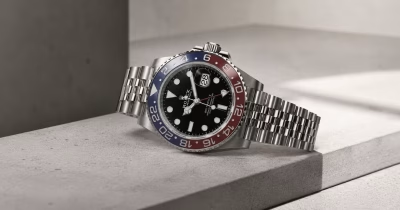
The jet age was born. As pilots began crossing time zones, Rolex partnered with Pan American World Airways to create the GMT-Master. Featuring a fourth hand and a two-color bezel (the famous “Pepsi” blue and red), it allowed pilots to read two time zones at once.
1956: The Day-Date
Finally, the ultimate power watch arrived. The Day-Date was the first chronometer wristwatch to display the day of the week spelt out in full, as well as the date. It was only ever made in precious metals (gold or platinum). Nicknamed “The President,” it has been the go-to watch for world leaders, CEOs, and even fictional tycoons like Tony Soprano.
The 1960s: The Racing Legend
The 1960s brought us the Cosmograph Daytona. Named after the famous Daytona International Speedway in Florida, this chronograph was designed for race car drivers to measure elapsed time and average speed.
Ironically, when it launched, it wasn’t a huge seller. The public preferred the flash of gold Day-Dates. But in the 1970s, actor and racing driver Paul Newman was spotted wearing a specific version of the Daytona (with an exotic “panda” dial).
Decades later, that association exploded. The “Paul Newman” Daytona has become the holy grail of watch collecting. In 2017, Paul Newman’s personal “Paul Newman” Daytona sold for nearly $18 million, making it the most expensive wristwatch ever sold at auction.
Materials & The Modern Era
Rolex is famously conservative. While other brands chase fleeting trends, Rolex iterates slowly, perfecting rather than revolutionizing. However, the late 20th century saw significant material science advances.
In 1985, Rolex became the first watch brand to use 904L steel exclusively. Unlike the industry standard 316L, 904L is harder to machine, but it takes a higher polish and resists corrosion better than almost anything else. They call it “Oystersteel” today.
This obsession with in-house capability extends to their foundries. Rolex casts its own gold and platinum in-house, ensuring every precious metal watch meets their standard of brilliance.
The Crown Today
Hans Wilsdorf died in 1960, but his legacy is perhaps the most robust in commercial history. He left the company to the Hans Wilsdorf Foundation, a private trust that ensures the majority of Rolex’s profits go to charity and the community. This unique structure explains why Rolex never cuts corners; it has no shareholders to answer to, only a legacy to uphold.
Today, the five-pointed crown on every dial isn’t just a logo. It represents the five original roles of the brand: precision, waterproofness, autonomy, craftsmanship, and prestige.
From the depths of the Mariana Trench to the summit of Everest, from the racetrack to the boardroom, Rolex didn’t just witness the 20th century; it timed it.
A Crown For The Ages, indeed.