- A. Lange & Söhne Watches
- Audemars Piguet Watches
- Bell & Ross Watches
- Blancpain Watches
- Breguet Watches
- Breitling Watches
- Bvlgari Watches
- Cartier Watches
- Chopard Watches
- F.P.Journe Watches
- Franck Muller Watches
- Girard Perregaux Watches
- Glashütte Original Watches
- Hamilton Watches
- Hublot Watches
- IWC Watches
- Jaeger-LeCoultre Watches
- Longines Watches
- Mido Watches
- Nomos Watches
- Omega Watches
- Oris Watches
- Panerai Watches
- Patek Philppe Watches
- Piaget Watches
- Richard Mille Watches
- Roger Dubuis Watches
- Rolex Watches
- Seiko Watches
- Tag Heuer Watches
- Tissot Watches
- Tudor Watches
- Ulysse Nardin Watches
- Vacheron Constantin Watches
- Zenith Watches


Speedmaster: How a Watch Went to the Moon
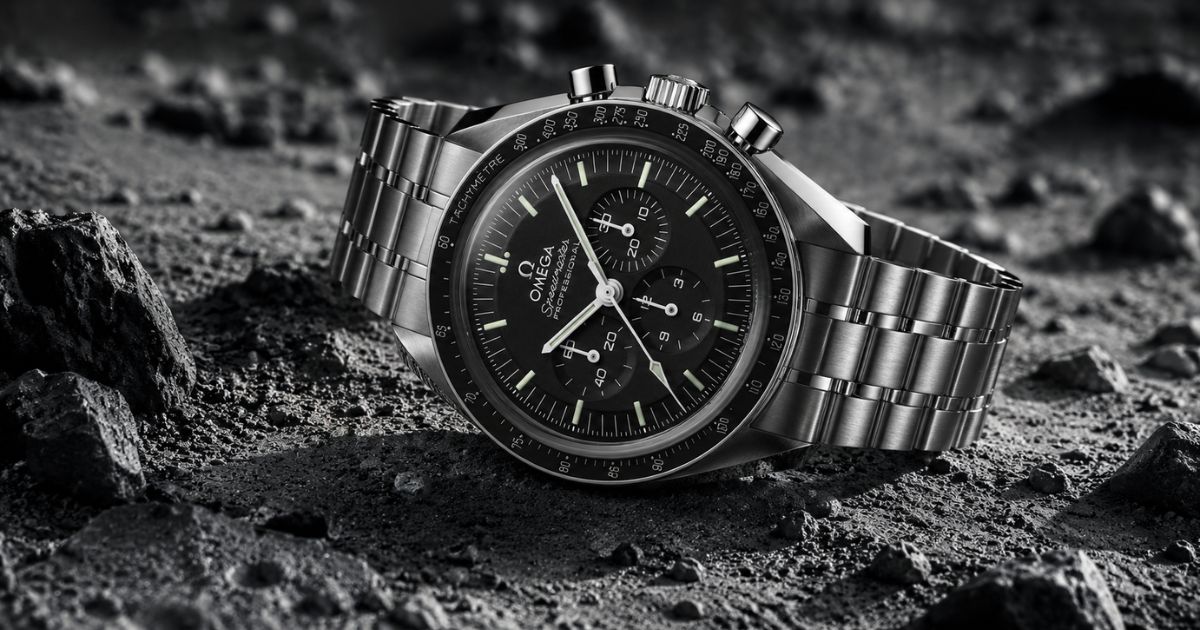
Few objects in human history can claim to have been present at a moment that fundamentally redefined our species’ place in the universe. The Omega Speedmaster, a watch originally designed for racing, holds that distinction. It is a story that transcends horology—a tale of unlikely survival, human ambition, and how a humble tool became an eternal symbol of exploration.
Born for the Track, Destined for the Stars
It is easy to look at the Speedmaster today and assume it was always a “space watch,” but its origins are far more terrestrial. Launched in 1957, it was part of a trilogy of professional tool watches from Omega, alongside the Seamaster and Railmaster. The Speedmaster was designed for motorsport and speed. Its defining feature was the tachymeter scale engraved on the bezel, which allowed drivers to measure average speed over a known distance. It was a “high-precision wrist computer,” housed in a robust case with a manual-winding movement.
This utilitarian focus meant it was built to be tough, accurate, and legible—qualities that would prove far more important than its creators ever imagined.
The Unofficial First: Wally Schirra
While the official legend began with NASA’s rigorous testing, the Speedmaster actually slipped the surly bonds of Earth a few years earlier. In 1962, astronaut Wally Schirra wore his personal Speedmaster (Reference CK 2998) on the Mercury-Atlas 8 mission. It was an unofficial choice, but it marked the first time an Omega Speedmaster had entered orbit. Schirra, a “watch guy,” chose it for its reliability, planting the seed for the watch’s association with the astronaut corps.
The NASA Gauntlet: The Tests That Made History
By 1964, NASA recognized the need for a standardized, official chronograph for its Gemini and Apollo missions. They sent a request for proposals to several watch brands, including Rolex, Longines-Wittnauer, and Omega. Hamilton also applied but submitted a pocket watch, which was immediately disqualified.
What followed were the most infamous tests in watchmaking history. NASA engineer James Ragan subjected the remaining chronographs to a series of 11 brutal tests designed to “test them to destruction” in conditions that simulated the extremes of space. The watches had to endure:
- Extreme Temperatures: 71°C (160°F) for 48 hours, followed by 93°C (200°F) for 30 minutes, and then 0°F (-18°C) for four hours.
- Thermal Vacuum Cycling: Fifteen rapid cycles in a near-vacuum, swinging from 71°C down to -18°C.
- Humidity: 250 hours in 95% humidity.
- Pure Oxygen: 48 hours in a 100% oxygen environment to ensure no off-gassing or combustion.
- Shock and Vibration: Brutal impacts of 40 Gs and intense, high-frequency vibrations.
- Acoustic Noise: Exposure to 130 dB of sound across a wide frequency range.
Of all the watches submitted, only one survived. The Omega Speedmaster (Reference ST 105.003) was declared “flight-qualified by NASA for all manned space missions” in March 1965.
The Moonwatch is Born
Just months later, the Speedmaster made history again. On June 3, 1965, astronaut Ed White wore his Speedmaster strapped to the outside of his spacesuit during America’s first spacewalk on the Gemini IV mission. A photograph of this “walk in space” cemented the association between Omega and the space program.
The ultimate triumph came on July 21, 1969. When Neil Armstrong and Buzz Aldrin stepped onto the lunar surface, the Speedmaster was there. Ironically, Armstrong left his inside the Lunar Module as a backup after the craft’s electronic timer malfunctioned. Buzz Aldrin, however, wore his Speedmaster on the outside of his spacesuit, making the Omega Speedmaster the first watch worn on the moon. Aldrin later noted, “few things are less necessary when walking around on the Moon than knowing what time it is in Houston, Texas. Nonetheless, being a watch guy, I decided to strap the Speedmaster on”.
A Legacy Forged in Crisis: Apollo 13
The Speedmaster’s legacy is not just about glory; it is also about survival. In 1970, the Apollo 13 mission suffered a catastrophic explosion. With the spacecraft crippled and its onboard computers powered down to conserve energy, the crew had to perform a critical engine burn to correct their trajectory for a safe return to Earth. The timing of this 14-second burn had to be precise. Astronaut Jack Swigert used his Speedmaster to time it perfectly, a decision that was instrumental in bringing the crew home alive. For this, Omega was awarded the prestigious “Silver Snoopy Award” by the astronauts, a testament to the watch’s role as a lifesaving tool.
The Enduring Icon
From the racetracks of the 1950s to the desolate landscape of the Moon and the high drama of Apollo 13, the Omega Speedmaster has proven itself to be more than just a watch. It is a symbol of reliability under extreme pressure and a reminder of human ingenuity. The story of how a watch went to the Moon is a testament to the idea that when you build something with integrity and purpose, it can achieve the impossible.